Many business owners assume expanding a restaurant POS system involves nothing more than buying another register, but the total cost depends on how the business is growing. Adding another checkout station to an existing location has different requirements than opening a second site, and hardware, software, installation, and ongoing support can all affect the final investment.
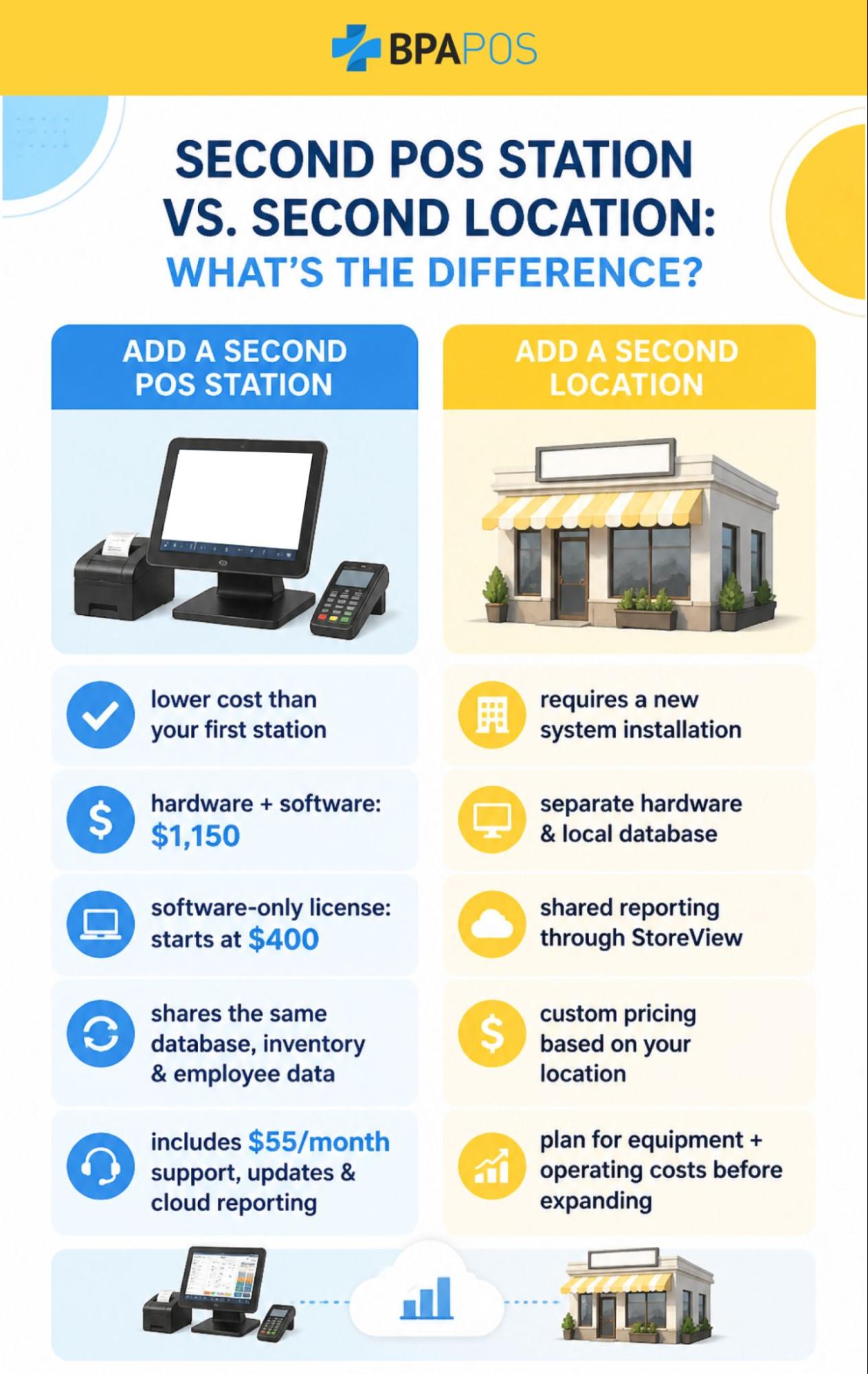
Quick Answer: Adding a hardware-and-software POS station to an existing BPA POS restaurant system starts at $1,150, while a software-only add-on station starts at $400 if you use your own compatible hardware. Every BPA POS system, including additional stations, requires a $69 per month license and support fee with no long-term contract. If you are opening a second business location, pricing is provided through a custom quote based on your operational requirements.
Station vs. Location Pricing at a Glance
A second hardware-and-software station for an existing system starts at $1,150, compared with $1,475 for a complete first Elite III station. Software-only add-on stations, installed on hardware you already own, start at $400 for the first added license and $70 for a brand-new single-station license. Every station, first or additional, runs under the same required $69 per month license and support fee, and there is no long-term contract or early-termination fee. A brand-new second location is a separate build, priced with its own quote rather than as a simple multiple of station pricing.
| Option |
What It Includes |
Starting Price |
| First Elite III Station (Restaurant) |
Complete hardware + software bundle |
$1,475 |
| Add a Station (Hardware + Software) |
Additional terminal, existing system |
$1,150 |
| Software-Only, First Station |
Software license, your own hardware |
$70 |
| Software-Only, Add a Station |
Additional license, your own hardware |
$400 |
| License & Support Fee |
Required monthly fee, no contract |
$69/month |
Our Retail and Hotel POS systems follow the same add-a-station structure but begin with different base prices: the Elite III Retail system starts at $1,330, and the Elite III Hotel system starts at $1,270. If you're planning to open a second business location, we'll provide a separate custom quote based on your specific deployment and licensing requirements.
Why a Second Restaurant Station Costs Less Than the First
A second station costs less than the first because you are not paying for a new base install, a new network setup, or a new round of staff training from scratch. The first Elite III station includes the initial software installation, the database setup, and the core configuration work that a second terminal simply plugs into. Adding a station reuses that existing database, menu, and employee file instead of building a new one.
That is why our restaurant hardware-and-software add-on price drops from $1,475 to $1,150. Software-only pricing works the opposite way: the first station is priced lower, at $70, because the $69 monthly fee is what funds ongoing support and updates; an additional software-only station runs $400 to reflect that per-license cost. This discount also applies specifically to the restaurant hardware bundle; our Retail and Hotel add-a-station pricing matches the first-station price rather than discounting it.
License and Support Costs for Additional POS Stations
The $69 per month license and support fee is a required part of every installation, and it covers US-based tech support, software updates, and access to StoreView cloud reporting. Because our system is built on the complete Business Plus Accounting backend, an added station reads from the same general ledger, inventory counts, and payroll data as your original terminal, so you are not paying for a second accounting system or a second inventory database. Restaurants that use gift cards, loyalty tracking, or online ordering through EatOnTheWeb also share that data across every station without an extra sync fee.
Hardware-Only vs. Software-Only Station Add-Ons
Hardware-and-software add-on stations cost more upfront than software-only licenses because they include a new terminal, while software-only add-ons let you install another license on hardware you already own or source yourself. A hardware-and-software add-on runs $1,150 and includes the terminal itself, ready to connect to your kitchen printer and cash drawer. A software-only add-on runs $400 and assumes you already have a compatible terminal, so you save on hardware but take on the job of sourcing and maintaining that equipment yourself.
Hardware Add-On Pricing
If you are adding a full station rather than just a license, we also sell the individual hardware pieces separately:
| Hardware Item |
Starting Price |
| Elite III Station (Add-On, Complete) |
$1,150 |
| Auto-Cut Thermal Receipt Printer |
$170 |
| Auto-Cut Dot Matrix Kitchen Printer |
$205 |
| Auto-Open Cash Drawer |
$120 |
Software-Only Add-On Pricing
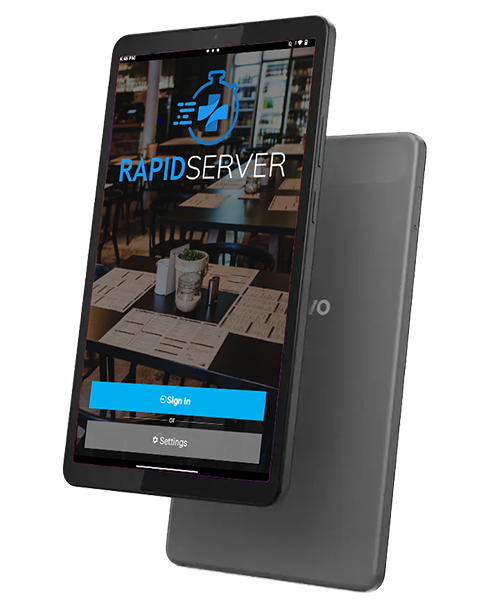
Software-only licensing works well for operators who already have compatible terminals or who are adding a tableside RapidServer tablet rather than a full countertop station. It starts at $400 for an additional license and still includes the same $69 per month required support fee, US-based help during business hours, and access to our shared database across every device. Used systems and clearance hardware are also available through our store for operators on a tighter hardware budget.
What Changes When You Add a Second Location, Not Just a Second Station
Adding a full second location changes the pricing conversation from a station add-on to a new system build, because a second address typically needs its own hardware, its own installation, and its own local database even if it shares reporting with your first site. Multi-location operators still benefit from a shared view of sales, inventory, and gift card balances through StoreView, but each physical location generally needs its own complete Elite III system rather than a single shared terminal. This is why we treat a new location as a custom quote instead of a flat add-on fee.
Because we install locally at each site, a second location keeps ringing sales even if that location's internet connection drops since the register itself does not depend on the cloud to process an order. The cloud layer, through StoreView and EatOnTheWeb, handles reporting and online ordering across every site, so a second location adds a second point of reliability rather than a second point of failure. Operators who are franchising or opening a second concept under the same ownership should also budget separately for gift card and loyalty setup at the new site, since balances and loyalty points can carry across locations once the systems are linked, which is a detail worth confirming on your quote call rather than assuming by default.
The U.S. Small Business Administration (SBA) recommends creating a financial forecast, including at least one year of projected monthly expenses, before committing to a new location because expansion costs extend well beyond new equipment. Forecasting startup costs, ongoing operating expenses, and expected cash flow helps businesses evaluate whether expansion is financially sustainable.
PCI Compliance Across Multiple Terminals or Locations
Every additional terminal or business location that accepts card payments can expand your PCI DSS compliance scope because the standard applies to every system, person, process, and network component involved in storing, processing, or transmitting cardholder data. As your payment environment grows, it is important to review the official PCI DSS scoping guidance to determine which systems and processes fall within the scope of compliance. We process card payments through Xplor Pay, which supports EMV and PCI-compliant payment processing, but businesses expanding to a second location should still review their overall PCI DSS responsibilities rather than assuming their existing compliance scope remains unchanged.
Our StoreView cloud reporting solution gives operators a centralized view of sales, labor, and inventory across every location, while our retail POS and hotel POS pricing pages explain costs for different business types.

Setup & US-Based Support: What to Expect When You Scale Up
Adding a station or a location includes US-based technical support during setup and beyond, available Monday through Friday from 8:30 a.m. to 5:00 p.m. MST, plus 24/7 emergency assistance. Our team configures every new station to match your existing menu, pricing, and employee permissions, so staff can use the new terminal without relearning the system. There is no long-term contract or early termination fee if your expansion plans change, and our support team is available to help throughout the entire rollout process.
The Hidden Costs of Adding Stations on a "Cheap" or Free POS
A "free" or low-cost POS station often does not include accounting, payroll, or inventory, so adding a second station on that kind of system usually means paying for a separate bookkeeping subscription just to keep the new register's sales in sync with your books. Third-party gift card providers also typically keep a share of unredeemed balances as breakage revenue, while we use no outside gift card processor so operators keep 100% of unredeemed balances and pay no per-swipe gift card fees. Stacking a second or third station onto a system that was never built on integrated accounting multiplies that double-entry problem instead of solving it.
The same math applies to payroll. A POS that only rings sales still leaves you keying hours and tips into a separate payroll system by hand for every added station and every added employee. Because our payroll module reads from the same install as the register, adding a station does not add a second data-entry job for your manager. Over several stations and several years, that avoided double entry is often worth more than the sticker price difference between a bargain terminal and a complete system.
Miriam Provine of Sweet Gregory P's Smokehouse Grill has described BPA POS as valuable because it combines POS and accounting in one system. That same integrated design also makes adding another station easier, since every new terminal connects to the same accounting backend instead of creating separate bookkeeping tasks. Our integrated accounting system explains how everything stays synchronized across stations.
Why Growing Operators Choose BPA POS
Mark Miller of Little Camille's By The Bay has praised BPA POS for doing "what others do for thousands less," a theme that matters even more once you are pricing a second station or a second location rather than a single first-time purchase. Because we're built on a complete accounting system rather than a bolt-on integration, expansion costs stay predictable: a new station adds hardware and a license fee rather than a new software subscription, a new payroll module, and a new inventory system layered on top.
Operators managing inventory across a growing footprint can also read more about inventory management and how recipe costing carries over automatically to every added station.

We've been in business for more than 30 years and have spent nearly 20 years refining our restaurant POS system, so adding another station or expanding to a new location follows a proven process that has helped independent operators grow for decades. Every station, whether it's your first or an additional one, is made and supported in the USA with no long-term contract and no early termination fee if your growth plans change. Our POS comparison page also shows how BPA POS compares with other systems as your business expands.

Frequently Asked Questions Second POS Station Cost
Does a second POS station cost the same as the first?
No. A first complete Elite III restaurant station starts at $1,475, while adding a station to an existing system starts at $1,150 for hardware and software, or $400 for a software-only license on your own hardware. The lower add-on price reflects that the base system, database, and menu setup are already in place.
Is there a discount for multiple POS locations?
BPA POS prices multi-location builds through a custom quote rather than a published flat discount, since each location typically needs its own complete system. Confirm current multi-location pricing and any available bundling by requesting a free quote.
Do I need a new license for every added station?
No. Our first station includes the required $69 per month License & Support Fee, but our published FAQ states that additional stations do not require an additional monthly license fee. If you're deploying POS systems across multiple business locations, contact us for a free quote to confirm how licensing and support fees apply to your specific setup.
Can I add a software-only station instead of buying new hardware?
Yes. A software-only add-on license starts at $400 and lets you run BPA POS on hardware you already own or source separately, which is a common choice for operators adding a tableside RapidServer tablet rather than a full countertop terminal.
What changes with PCI compliance when I add a second location?
Your PCI DSS compliance scope generally expands with each additional terminal or location because more systems, people, and processes become part of the cardholder data environment. Businesses should review their PCI DSS responsibilities whenever they expand their payment environment. We process payments through Xplor Pay, which is built for EMV and PCI compliance, but operators adding a location should review their overall compliance scope rather than assume it stays the same.
Does StoreView cloud reporting cost extra for multiple locations?
No. StoreView cloud reporting is included at no additional charge and lets operators view sales, labor, and inventory data across every station and location from one dashboard.
Before you request a quote, it helps to have a few numbers ready: how many stations you are adding, whether you already own compatible hardware, whether the new station is at your existing address or a new one, and whether you expect to add gift card or loyalty tracking at the new site. Having those answers up front lets our support team give you an accurate price on the first call instead of a rough estimate that changes later.
How long does it take to add another POS station?
Most additional stations can be configured much faster than an entirely new installation because they connect to an existing BPA POS database and inherit the current menu, pricing, inventory, and employee settings. The exact timeline depends on hardware availability, installation scheduling, and whether additional peripherals are required.
Can existing employees use the new station immediately?
Yes. Because additional stations share the same employee database and permissions, staff generally log in using their existing credentials without requiring separate employee accounts. Managers can adjust permissions as needed if the new station serves a different operational role.
The Cost of Adding a Second POS Station or Location
Adding a second POS station is usually a straightforward hardware-and-license decision, while opening a second location requires a more comprehensive plan that considers hardware, software, PCI DSS compliance, reporting, employee setup, and ongoing support. The total cost depends on your business type, existing POS configuration, and how many stations or locations you plan to add, so the figures above should be treated as starting points rather than fixed prices.
Whether you are expanding a single store with another checkout station or preparing to open a new location, planning ahead helps you avoid unnecessary costs and ensures every new terminal connects directly to your existing menu, pricing, inventory, employee permissions, and accounting. With more than 30 years of experience serving independent businesses, BPA POS provides US-based implementation, training, and technical support to help make expansion as smooth as possible.
Get a free custom quote today to receive pricing tailored to your business, along with expert guidance on hardware, software, licensing, payment processing, and deployment. Our team will help you choose the most cost-effective solution so you can expand with confidence, whether you're adding one station today or building your next location tomorrow.